
Renown (ve for NFTs)


Early stage liquid tokens (ICM tokens, genesis NFTs, land, etc.) for products that take years to build revenue-generating businesses are BROKEN.
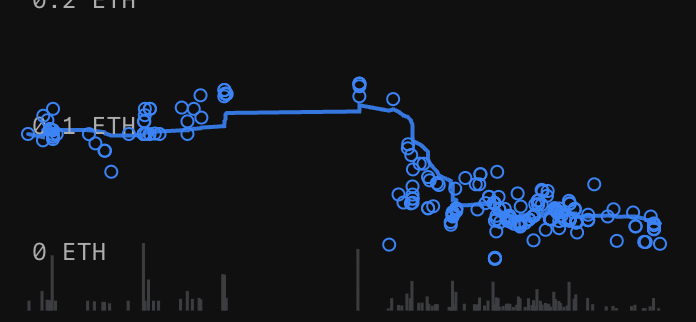
Why? ➡️ Almost all of these trade the same way - a top shortly after initial generation & volume spike, followed by a sharp correction that rarely recovers until the project finds PMF (if ever). The few that hit PMF later might pump years after launch, but their earliest supporters and long term holders still generally lose out.
What do you mean they lose out?
Long terms holders are effectively penalized for holding early stage assets (instead of rotating) if there is no additional utility based on hold duration of assets / tokens. Projects might not mean it this way, but treating early holders the same as more opportunistic buyers who buy back later directly hurts alignment by skewing the risk and reward tradeoff for these assets, creating massive inefficiencies.
What's confusing is this is already a solved problem in DeFi 🤔. In 2020, @CurveFinance faced the same issue. Curve needed longterm LP's to make their AMMs work but everyone kept yield-hopping the moment rewards dipped, so they implemented veTokenomics (vote-escrowed tokens) which directly tied TIME HELD to POWER. This soon spread quickly across Defi - veCRV, veBAL on Balancer, ve(3,3), veVELO, and other models, where users have a time-weighted influence score that controls governance, emissions, and rewards - ⚡️ the longer you lock, the more aligned you are and the higher your influence and yield.
This worked incredibly well (obviously with a few caveats). If early holders have to lock (or hold) tokens or NFTs to gain future voting power, emissions, etc. benefits, it filters out short term speculators / rewards conviction holders, and creates a temporal moat between builders and opportunists - directly counteracting the "liquid too soon" problem of crypto by de-incentivizing liquidity until the product matures.
In this article, we propose a similar solution for the NFT collections for early stage / ICM projects - ✨ veNFTScore - a ve-like system that can be easily applied to most pre-TGE crypto gaming (or consumer) early stage apps that integrate NFTs deeply, and something that easily ports over to vote-escrow token models on TGE.
Background
In Cambria's case, we have three live NFT collections:
- Cambria Founders (genesis) - 1500 "true fans" / the core
- Cambria Cores - factory NFT controlling cosmetics & pets ingame
- Cambria Islands - controls player Islands / property in game
Re. "Genesis NFTs" - The most common meta rn for pre-TGE crypto gaming projects is launching a "genesis" NFT that is "significantly considered" for a future airdrop, making it a way to get pre-token, liquid exposure to the project w/ floor price serving as a proxy for its est. value.
When we launched the Founders NFT in Sep 2024, we implemented an early prototype of this "holding" score with the "Loyalty Score" system.
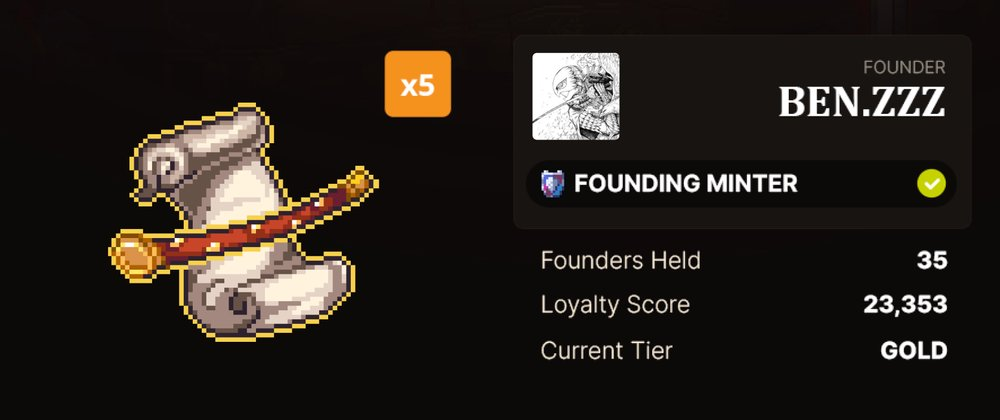
This score simply tracks the # of blocks onchain since the NFT was last transferred or minted. If you sell the NFT, the score resets (players can link multiple wallets to their account so Loyalty Score doesn't get reset when NFTs are transferred between their own wallets). Additionally, we added a "First Founder" designation (similar to a veToken "boost multiplier") that adds an additional desigination for players that have held since mint (400 or so out of the original 1500 minted are still "First Founders") - a status that we've used to drive utility, perks, and other benefits to.
However, it's now time for us to expand this "loyalty score" system to something broader that covers all of our NFTs / assets and has a lot more flexibility - Renown - our veNFTScore for Cambria NFTs.
ve for Gaming NFTs
While DeFi solved the holder/staker alignment issue for fungible tokens, imo NFTs have been underexplored for this use case. NFTs are inherently non-fungible entities - perfect for tracking provenance, ownership history, and commitment. Yet most NFT-integrating projects still treat every wallet with their NFTs the same, regardless of how long someone’s held or contributed.
That’s what Renown fixes.
Renown applies the same “vote-escrowed” logic - time-weighted, loyalty-based power - to NFTs. It aggregates scores across all of a player's NFTs into a combined veNFTScore - an evolving record of its holder’s conviction, activity, and engagement across the eco.
Holding longer and committing your NFT to in-world activities (Attunement) all increase its Renown. Selling or transferring it resets the clock. Over time, your NFTs become reputation-bearing entities that give you certain privileges and direct utility.
The same way veTokenomics aligned liquidity providers with protocol success, Renown aligns early NFT holders - creators, players, guilds, and early believers - with the long-term arc of projects like Cambria that take many years to come to fruition.
Our Implementation
Each NFT tracks its own Renown Score, which represents its cumulative holding duration ("Lock Duration") and other variables. A player’s total Renown is the sum of all NFT-level scores in their account. Our implementation uses a formula that incorporates the following:
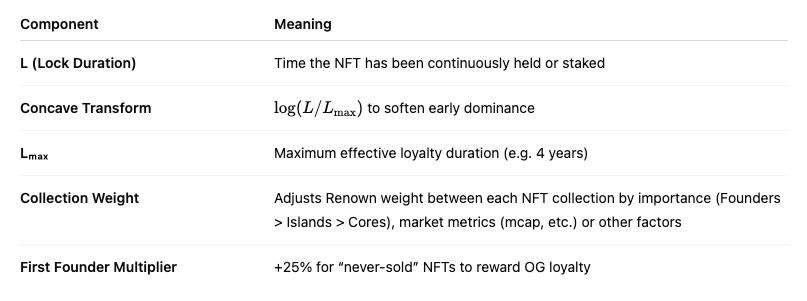
into the following formula

where the 0.25 is an example of additional boost multipliers.
Notes:
- Lock Duration per NFT can be arrived at in a couple of different ways, based on what you want the ideal behavior to be. E.g. for our Founders NFT, its holding duration. For Cores, its staking to earn shards. We use a normalized metric like the # of blocks (time) held or staked.
- Lock Duration can additionally involve actual staking lockups for the NFTs themselves instead of using hold times
- You can use either just straight up linear duration, or curve it (we're leaning towards adding some diminishing returns with a log transform).
Attunement
In addition to Renown, we're working on ways to additionally commit NFTs with renown weight to various game activities via "Attunement" -> binding e.g. a Founder NFT to a specific game activity, asset, guild, or ecosystem product in a way that leverages its renown score for yield, cosmetics, perks, etc.
This effectively makes holders choose between which part of the ecosystem to allocate their vote-escrowed influence to, similarly to Curve vote gauges - creating natural scarcity and a metagame of Renown allocation ("do I attune my Founder NFT into my island for X, or into my guild in Gold Rush for Y?"). Over time, attunement histories also becomes a part of the NFT's identity and participation history onchain.
Advantages of veNFTs
What are some advantages of NFTs for ve-like utility?
- Each NFT can have its own "loyalty history" - verifiable onchain history of ownership and usage - making it "personal" vs fungible tokens especially through the context of a product like an MMORPG
- Usage of Renown (perks, boosts, etc.) can be tailored to specific NFT collections instead of wallet-level balances. E.g. we want to release a new feature with perks based on Renown but SPECIFICALLY Founder NFT Renown - multiple types of collections increases design space
- Fungible tokens are easy to game, requiring artificial locks and penalties - with NFTs, time-weight is attached to NFT metadata
- NFT Supply can be limited and more easily controlled, which is a huge advantage for early stage teams
Disadvantages of veNFTs
The veNFTScore isn't perfect- one of the major issues is longterm balance and potential stagnation with an entrenched class of high-Renown holders, creating a lack of incentives to buy-in for new holders.
A couple ideas for this:
- Having a Max cap for Lock Duration - e.g. 4 years or smth that closely mirrors e.g. long term Token Vesting dynamics
- Diminishing returns on Lock Duration (log, etc. curves)
- Rewarding fresh activity with seasonal bonuses, new holder boosts
- Some of an NFT's Renown (e.g. 10%) gets transferred to new buyer
Additionally, the NFT itself has to provide some early utility to the project's success early on - holders adding value, early funds for development, etc. Otherwise, you'd likely need to force some active participation to continue accumulating Renown (or preventing it from decaying).
NFTs are also much less liquid than tokens, especially if Renown incentivizes HODL. This can be worked around in the future with wrapper tokens, NFT lending markets, etc. to give holders liquidity without transferring and resetting the score.
Ways to Use veNFTScores

A couple examples of ways we've used this at Cambria:
- Higher Weight on NFT reveals (Islands)
For the Island NFTs, we are applying a scaling "luck boost" where high Renown score holders have a slightly boosted chance to hit higher-tier Islands (especially T5) as our "finger on the scale" to ensure good starting distribution (while still allowing lucky minters to hit T5's and flip them for massive profit).
- Giveaway / Raffle / Perks - Weighted Priority
- Distribution for new NFTs, Tokens
Things we're thinking about for the future:
- Governance Power
- Emissions
- Fee Discounts / other value accrual
- "Bribes" - influence on game design and who gets chosen